Sahaj TTP Review Portal
A multi-role review portal that took Sahaj's Teacher Training Program from scattered emails to one accountable, auditable workflow.
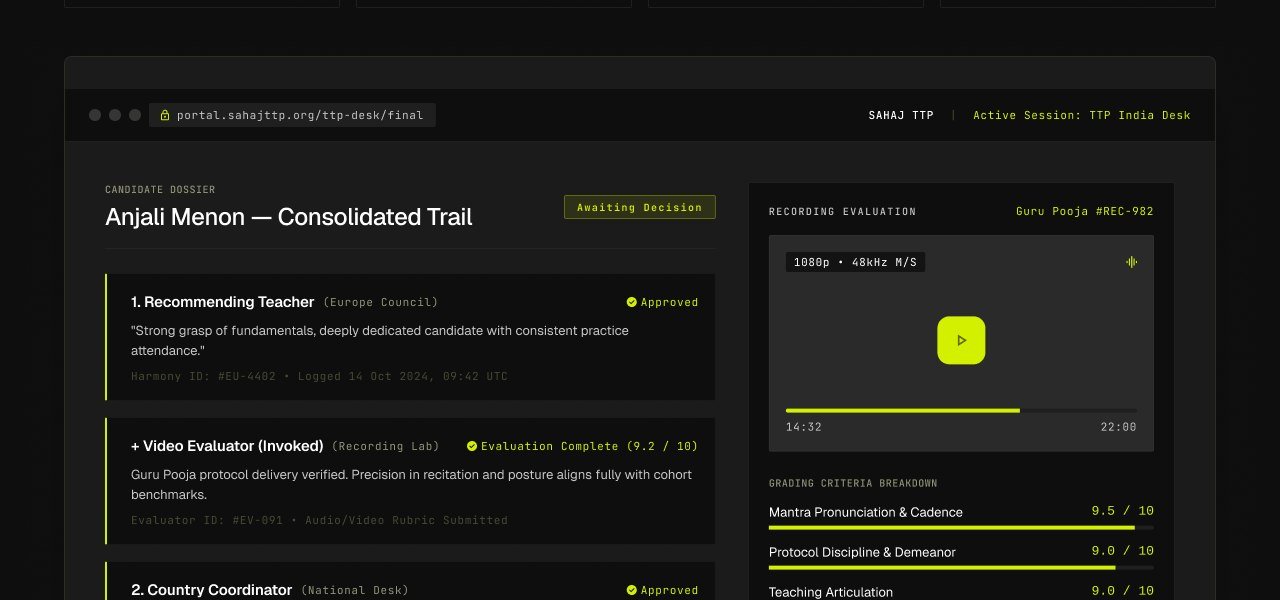
From Uncoordinated Inboxes to a Unified System of Record.
The Systemic Deficit — Silent Bottlenecks
Coordinating the review by email meant no single reviewer could see what the others had said, remarks were easy to lose, rejections had no clear record of why, and there was no way to track how many applications were stuck at which stage.
The Interaction Model — Sequential Visibility
Rather than a one-size-fits-all approval tool, each stakeholder's actual responsibilities were mapped into a dedicated workspace, letting a decision at one stage automatically carry its remarks forward to the next.
The 5-Stage Approval Architecture
Recommending Teacher
First eligibility review and initial validation of regional candidate credentials.
Recording Evaluator
Invoked only for audio/video playback when a secondary rubric consensus is required.
Country Coordinator
Consolidates local review with complete oversight of teacher recommendations.
India Sahaj Desk
Central clearinghouse validating national coordination against central data ledgers.
India TTP Desk
Final supreme authority with exclusive capacity to overturn previous rejections.
Engineered System Capabilities
Federated login by country
Teachers and coordinators sign in with Harmony credentials; India-based desks use India CRM, bridging disparate auth architectures into one seamless session.
Sequential approve / reject
Every stage requires an explicit decision plus mandatory remarks. Rejections are routed straight to the India TTP Desk to eliminate ghosted applications.
Audio/video evaluation
Evaluators play back Guru Puja recordings against a synchronized rubric HUD with pinpoint timestamped feedback and criteria scoring.
Consolidated remarks trail
Every downstream reviewer sees the full chronological history of prior feedback and applications, every decision carries mandatory attributable remarks.
TTP Desk override
The final desk can reopen and reverse an earlier rejection without wiping the historical record, preserving complete audit accountability.
Dashboards & audit log
Each role gets a live count of reviewed, pending and forwarded applications; every micro-interaction is recorded in an immutable event trace.
Zero lost files. Total audit defensibility.
The portal replaced an email-based hand-off with a single system of record. Five previously siloed reviewer groups now share one workflow and one audit trail, every decision carries mandatory attributable remarks, and role-specific dashboards give each stakeholder group visibility into their own queue without exposing others' data.