Jan Seva
A role-based grievance management platform turning every paper petition handed to a Minister, MLA, or MP's constituency office into a real-time, trackable digital case.
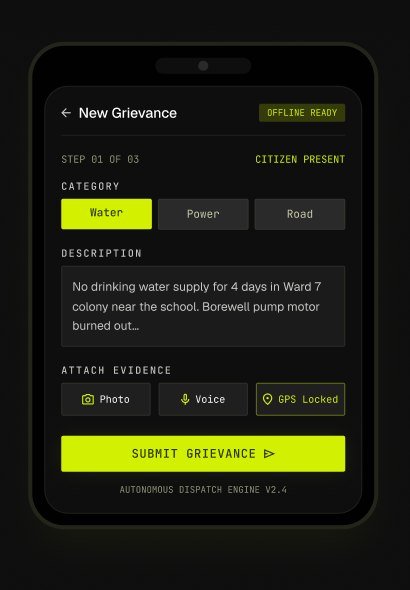
Evidence-First Capture Replaces Verbal Hearsay with Verifiable Data Points.
The Reality of Paper Petitions
Every day, hundreds of citizens walk into an MLA or MP's office holding physical paper petitions. The traditional flow relies on cardboard folders, manual dispatch registers, and verbal follow-ups. Cases sit unattended in jurisdictional limbo without escalation triggers.
Digitizing the Human Artifact, Not Reinventing It
“The existing manual process — walk-in, verbal description, paper file, hand-carried folder — became the operational backbone of the digital ticket lifecycle. Nothing artificial was invented; the paper protocol was digitized one node at a time.”
The 7-Step Grievance Lifecycle
Citizen walks in
Describes the issue in person at the local constituency office.
Ticket created
Data captured via OCR, photo, voice note and GPS tag.
Secretary verifies
Category, priority, SLA, and duplicate detection confirmed.
MLA reviews
Digital dossier mandatory before dispatch to department head.
Officer resolves
Field inspection logged with photos and proof.
Citizen notified
Instant SMS / WhatsApp resolution proof, verified before closure.
Feedback & close
Citizen confirms satisfaction; case cannot close without citizen consent.
Six Connected Capabilities
Ticketing core
Generates unique ticket ID and print-ready QR codes for physical slips. Enforces automated SLA timers, escalation routing logic, and tamper-proof immutable audit logs.
Rich evidence capture
Photo, video clips, and compressed voice notes. Integrated touchscreen digital signature capture, hardware GPS geo-tagging, and an offline capture engine with autonomous background sync.
Multi-channel alerts
SMS, WhatsApp interactive messages, mobile push, and email status updates fired instantly upon every ticket status change. Includes simple two-way WhatsApp survey replies.
AI-assisted triage
On-device OCR parsing handwritten physical petition papers, semantic department recommenders, similarity clustering for duplicates, and instant multi-dialect translation.
Role-based dashboards
District tailored views for MLA, Secretary, Field Officer, and Citizen. Features deep aging telemetry, SLA breach alerts, ward heatmaps, and performance scorecards.
Security & access
Fine-grained RBAC across 8+ specialized administrative roles. Secure OTP and biometric authentication, hardware-backed AES-256 encrypted media storage, and forensic access logging.
Digitizing the Human Artifact
100% Ghost Traceability, 0 Visits Status Enquiries, and less than 48 Hrs First SLA Trigger — the paper protocol was digitized one node at a time without discarding the field officer's existing rhythm.
Architectural Reflections
▸ Permissions before pixels
With 8+ distinct roles sharing one single record, the permission matrix had to be locked down before a single UI screenshot was drawn. A field officer can modify a category set by an MLA, and the entire hierarchy collapses. Security boundaries define the layout.
▸ Offline isn't a checkbox
Junior engineers inspecting broken water mains in electric poles in rural India regularly lack mobile data. The app was architected as an offline-first SQLite database that triggers background synchronization once cellular handshake is re-established.
▸ Speak the office's language
Standard Silicon Valley product vernacular ('In Review', 'Sprint Backlog') alienated clerical staff. Labels like 'File Received', 'Under Triage', and 'Sanctioned by MLA' were lifted directly from the physical rubber stamps already sitting on office desks.
▸ Design for low bandwidth first
Machine-learning features remained assistive rather than blocking. If the handwritten OCR service times out over a 2G connectivity, the clerk simply types two words and moves forward. The core lifecycle never pauses for an API call.