Namma Transit
A service design exploration into why Bengaluru's public transport loses riders to private vehicles — and a concept for unified commuting across bus, metro and last-mile feeders.
Overview & Problem Context
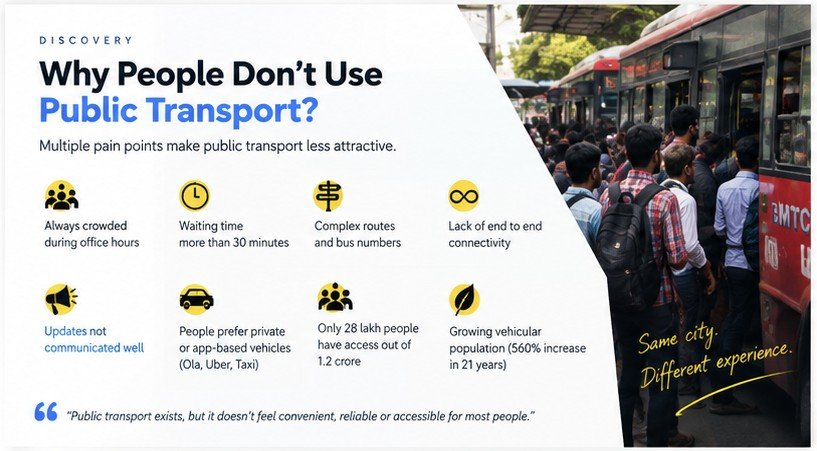
6 Core Transit Friction Points
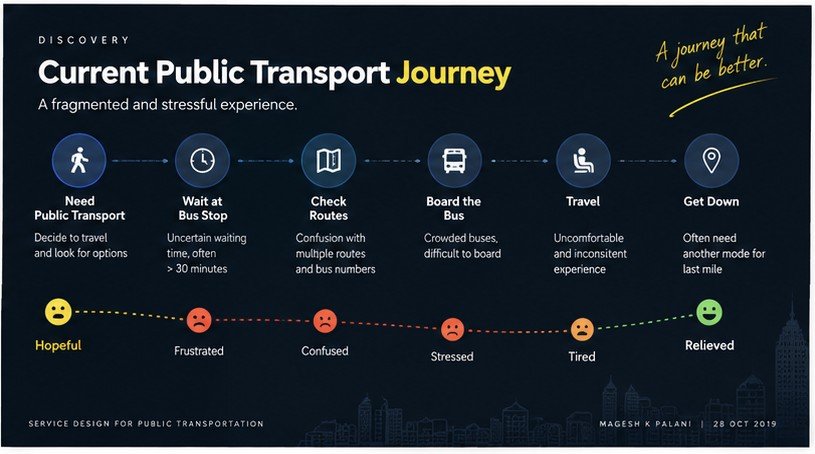
No end-to-end service (lacking last-mile connections forces commuters back into private or personal vehicles for their first/last leg journeys). 30+ min bus wait times (unpredictable bus schedules and unfractured arrival intervals force bus stops into high-friction dead zones). Confusing routes and numbers (opaque alphanumeric bus routes without directional clarity preferences alienate riders). Peak hour overcrowding (bottlenecks during morning and evening rush without dynamic rebalancing or crowding notifications). Poor service updates (route detours, line interruptions, and schedule delays rarely reach commuter devices in time to adjust trips). Language barriers (monolingual display boards create persistent friction for non-Kannada and pan-Indian tech workers in tech corridors).
Rider Quality Impact
Transport stands as the single largest contributor to Bengaluru's urban air pollution at 20%, directly linked to private vehicular dependency.
Service Design & Discovery Deck
6-Phase Service Design Framework
Research
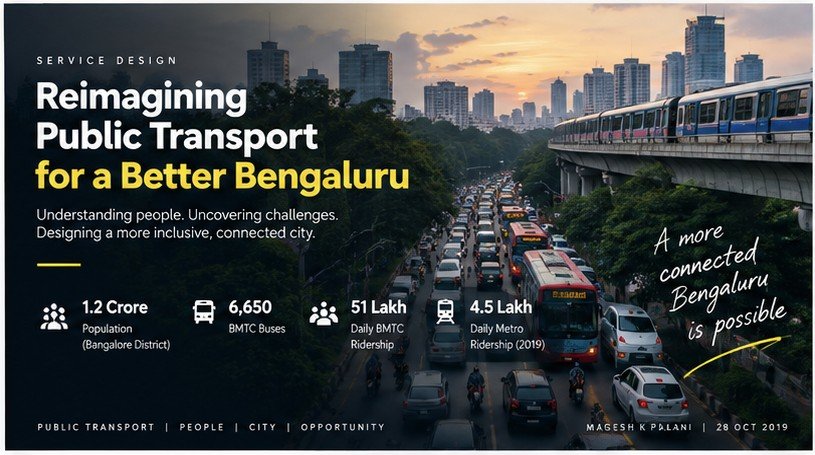
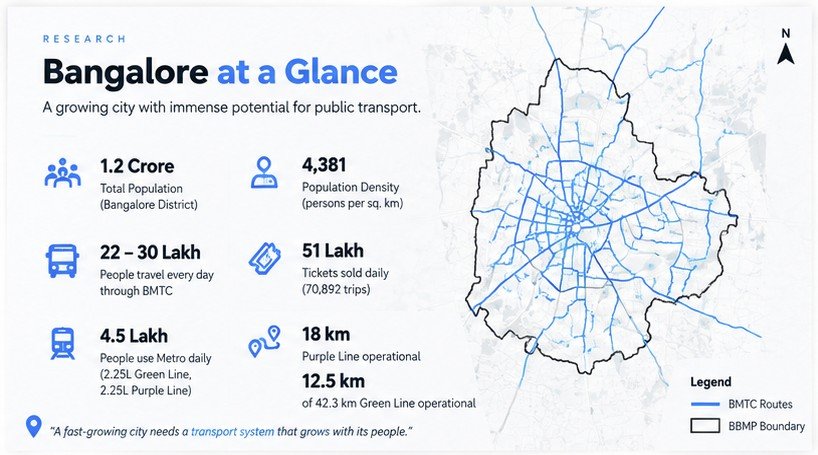
Secondary analysis into population statistics, BMTC fleet allocation, and Namma Metro passenger service velocity.
Discovery
Mapped commuter departure patterns via journey mapping across both Frequent and Non-Frequent particulate emissions.
Problem Framing
Power vs. interest stakeholder matrices and correlating mental transport shares with localized particulate emissions.
Solution
Persona-led design working on unified fixed high-capacity rail lines with flexible feeder fleets and shared micro-mobility.
Concept
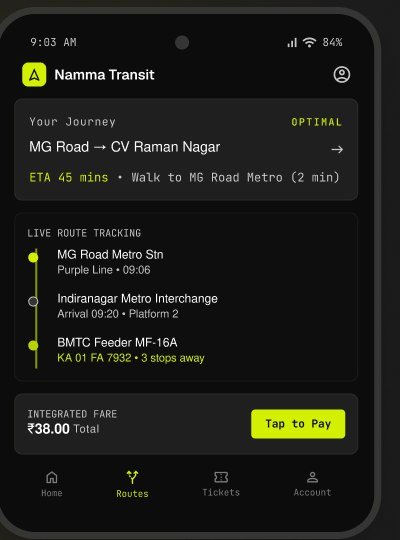
Namma Transit: a synchronized commute companion mobile app optimizing for turn-by-turn multimodal wayfinding.
Impact
Dynamic route scheduling blueprints, automated fare clearing mechanisms, and unified municipal authority governance.
The Concept App Features
Plan a Trip
Search once, see every mode — bus, metro and feeder — synthesized in one comprehensive itinerary with calculated transfer walking times.
Compare Routes
Fare, time, carbon footprint, and real-time passenger crowd density shown side by side across competing route topologies.
Live Tracking
Telemetry-driven real ETA and vehicle capacity telemetry, eradicating reliance on static published timetable estimations.
One Tap to Pay
A frictionless, single cardless smart pass valid interchangeably across BMTC buses, Namma Metro gates, and verified feeder autos.
“Seamless connectivity, choice of transport mode, and integrated pricing are the mechanisms through which we create equality in our public spaces.”
Design Rationale, Namma Transit Concept