Healthcare SaaS Management Platform
A modular, multi-tenant Hospital Management SaaS — from a 29-section product brief to a working, browser-verified Phase 1 across patients, appointments, EMR, billing and RBAC.
Turning a Dense 29-Section Brief into a Verified Hospital OS.
Executive Summary
The spec described a mature, multi-tenant enterprise platform — Laboratory, Pharmacy, Telemedicine, CRM, a Super Admin console, subscription billing, AI assistants — all at once. If I had tried to honor every section literally, the job would have taken a decade before a single working screen existed.
The Architectural Challenge
Three-Tier RBAC Enforcement: guaranteeing 10 roles receive tailored navigation, page-route guards, and server-side mutation authorization rather than hidden CSS selectors. Multi-Tenant Branch Isolation: 1 organization with 3 distinct branch nodes needed hardcoded single-branch assumptions torn out. Realistic Seed Data Seam: an authentic Indian clinical specialties, medications and AI geodata seed that surfaced actual software bugs during prototyping.
Phase 1 Shipped Architecture
Organization & RBAC
Multi-branch organization model with departments, users and a permission system enforced at the row, page and server layers for all six core roles.
Patients
Registration, search by name/DOB/phone and a chronological visit timeline from registration through to final invoice settlement.
Appointments
Day / Week / Month calendar view, doctor and department filters, and conflict-free booking validated in real time against physician working hours.
Doctors
Directory with working hours, capacity, appointments and per-doctor analytics on no-shows and departmental revenue.
Consultations & EMR
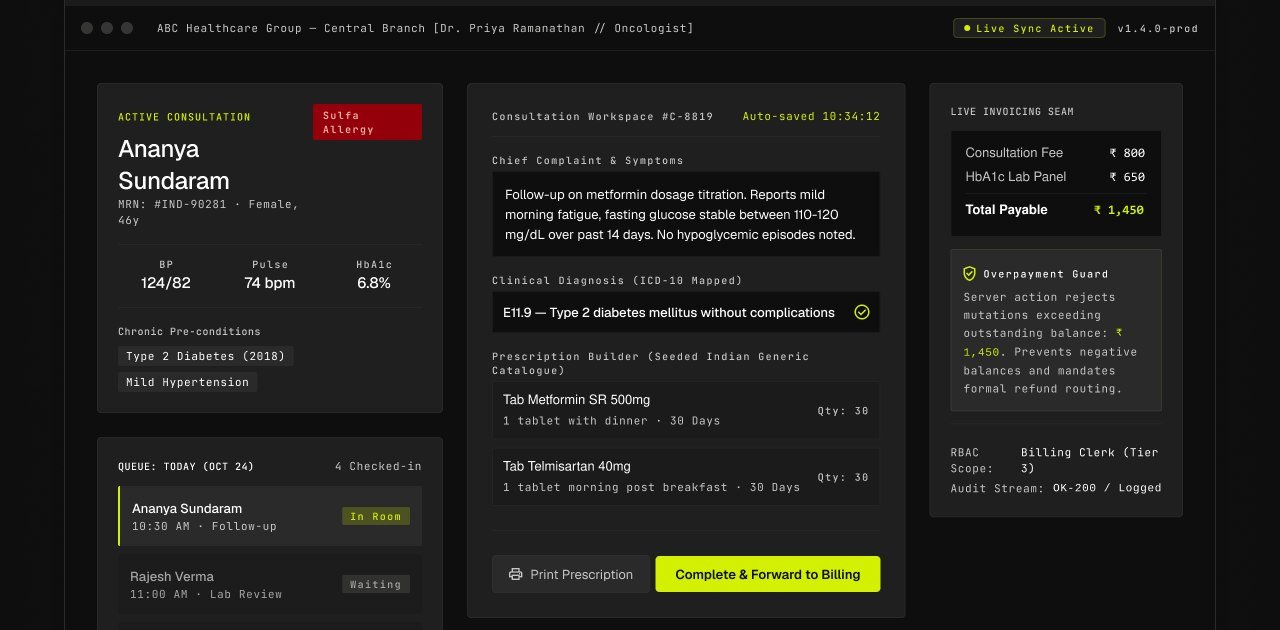
A doctor's queue, persistent patient clinical timeline, structured ICD-10 clinical diagnoses capture, and an instant printable prescription pipeline.
Billing
Invoicing directly from a consultation or ad-hoc, partial and full payments with a server-enforced overpayment guard, refunds and thermal receipts.
The Three Critical End-to-End Flows
New Patient Onboarding & Conflict-Free Scheduling
Doctor Consultation & Persistent Clinical EMR
Billing Pipeline & Server-Side Overpayment Guard
Quality Management & Process Library (OPAL)
Enterprise compliance framework and digital process standardization for high-precision manufacturing.
Key Reflections from the Build
▸ A phased MVP beats a flat feature list
Building 8 deep modules with real data flowing between them (not a more credible product story than a thinner slice of 29 sections) would have meant every feature stayed a shallow, disconnected stub. Going deep and narrow beat going wide and shallow.
▸ RBAC needs three layers, not one
Hiding a nav link is a UX nicety, not security. Every permission check had to be repeated at the page level (redirect on direct URL entry), on the server action layer, and in a hidden action row so a doctor or billing staff couldn't act on an unauthorized record.
▸ Realistic seed data surfaces real bugs
Generating patients with a real Indian name pattern (like Hyderabadi Chennai) — a generic placeholder name never would have surfaced that. Realistic data is testing tool, not just a cosmetic detail.
▸ A swappable data seam pays for itself immediately
Routing every mutation through a service layer — even one backed by an in-memory store — meant the mock data layer could swap for a real address-generation library, adding branch-qualified labels to a dashboard chart, without touching a single page component.