Engagement Management System
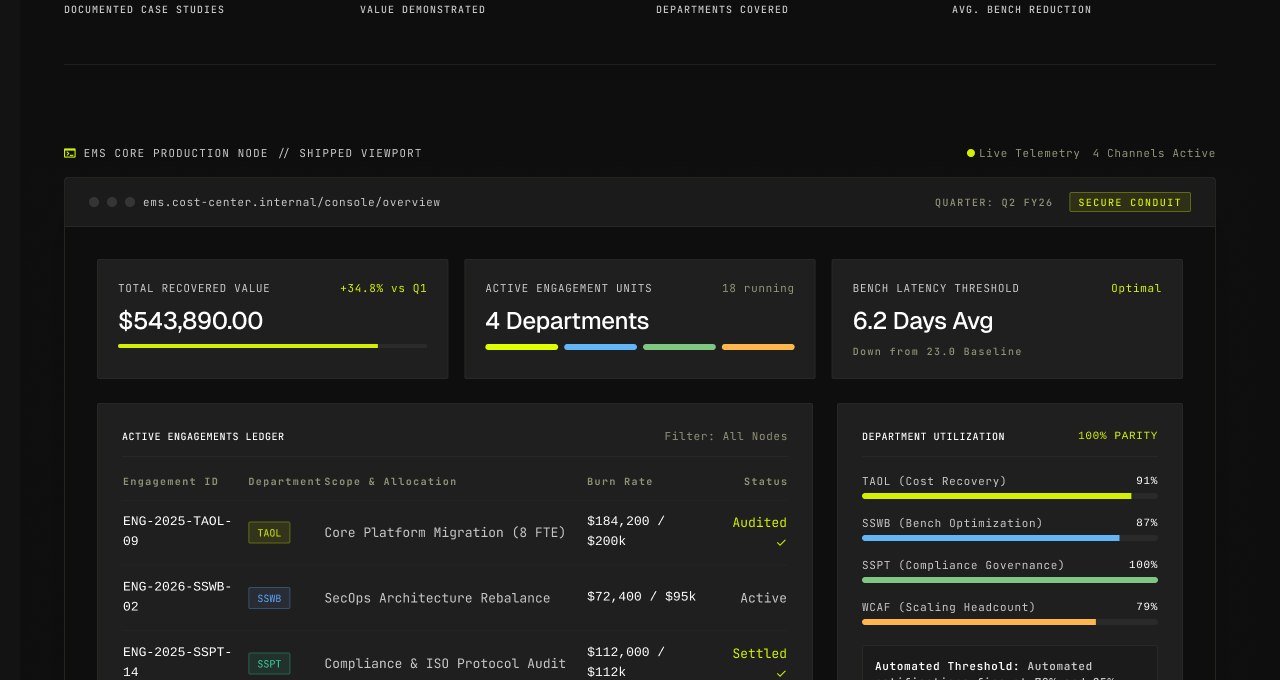
An internal cost-visibility platform that turned informal cross-department work into tracked, billable engagements — recovering $543K+ across four departments.
The Friction of Shadow Billing & Invisible Bench Time
Overview
The Engagement Management System (EMS) gives cost center admins, department requesters and engagement managers one system for tracking cross-department work — resourcing, time billing and budget — that used to live in scattered spreadsheets and informal agreements.
Challenge & Approach
Cross-department work was tracked informally or not at all, so real costs went unrecorded and bench time between engagements was invisible, and departments had no audit trail for internal billing. I built the interface on a shared design-system foundation first — one set of tokens, components and department-color conventions used across every module — so each team's workflows stayed distinct while the underlying language stayed consistent.
The Design System Foundation
Token-based color system
Primary, semantic business / warning / alert and department-specific color scales used consistently across every dashboard.
Typography & data hierarchy
An inter-level type scale tuned for dense dashboards — distinguishing metrics, table labels and states at a glance.
Component library
Buttons, badges, tabs, cards and data tables documented in default, hover, disabled and every intermediate state.
Data & chart primitives
Shared bar / gauge / status chart components so budgets, utilization and audit trails read with consistent visual language across every module.
Case studies — real outcomes across four departments
Eliminating Shadow Billing in TAOL Cross-Functional Projects
Reducing Resource Bench Time Across SSWB Engineering
Full Audit Trail for SSPT Compliance Engagements
Scaling WCAF's Budget Visibility During Rapid Headcount Growth
Launching the First Cross-Department Innovation Sprint
Outcome
Five documented case studies across four departments demonstrated $543K+ in recovered or protected value, with an average 74% reduction in resource bench time. Every rollout ran on the same shared design system, so departments could compare their dashboards directly instead of translating between four different tools.
Reflections
▸ Formalise before you track
Every successful adoption started with converting informal engagements into formal engagements — even retroactively. The system only works where every reduction relationship has an official record.
▸ Alerts replace reporting
Departments that set up threshold alerts (75% / 90% budget consumption) had zero surprises. Real-time signals are more effective than weekly reports for budget governance.
▸ Role clarity unlocks speed
The approval workflow only accelerated once every stakeholder had a specific title — Cost Center Requester and Engagement Manager were the most commonly confused friction point.
▸ Cross-department trust is the hardest part
The TAOL shadow billing case succeeded because all four departments agreed upfront on billing rates and rules. Technical implementation was straightforward — stakeholder alignment took the most time.